


It Started with a Seemingly Simple Goal
I wanted a brushless motor to implement a buttery-smooth spring-return-to-center behavior so I could use it as a “smart knob.” In addition, I wanted it to spin at low speeds without that characteristic “cogging” or jitter – just dead-silent, smooth rotation. That simple curiosity landed me deep in the world of Field Oriented Control (FOC) and the SimpleFOC project.
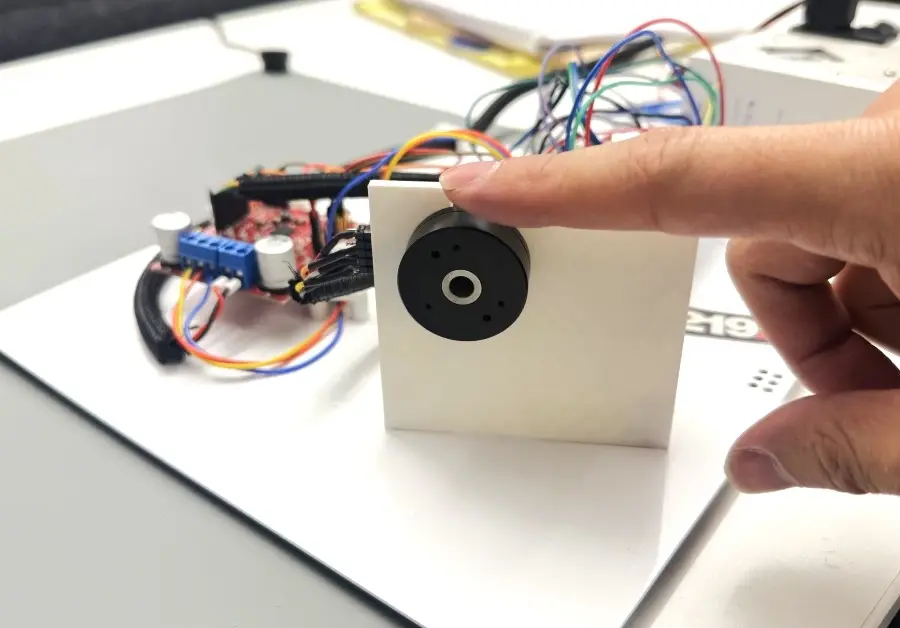
What was supposed to be a low-stakes experiment – basically just hack-wiring a microcontroller to a driver board to a motor – turned into a reminder of how humbling motor dynamics can be. The first step was to mount an angle sensor relative to the motor to enable the control. Fortunately, one of our MEs whipped up some custom 3D printed parts and I assembled everything on one of our handy Circuit Keeper boards.
Then you actually get to start on the motor control. You can read textbooks on FOC all day, but nothing teaches you the math quite like the physical frustration of tuning PID loops until the motor finally “sings.” Using SimpleFOC was a great starting point for getting things off the ground. After some tweaks and tinkering, I was able to get the behavior that I was looking for.
Why “Tinkering” Matters in High-Stakes Design
At our engineering firm, we handle everything from consumer electronics to medical GUIs to surgical robotics. You might think messing around with community-driven libraries is a hobbyist distraction, but I’d argue it’s one of the best ways to keep your engineering intuition sharp.
The proof came a couple weeks later.
A client of ours was in a high-pressure R&D sprint for a custom robotic controller. They needed quick integration of a BLDC motor to implement a new interaction mode and the deadline was looming. Because I had just spent some time wrestling with the exact nuances of that FOC loop, I didn’t need to “ramp up” on their problem or even wait for hardware to arrive from Digikey.
Our team was able to:
- Impress on day one by demonstrating basic functionality at the client’s office with our prototype that was ready-to-go with just a few firmware tweaks.
- Shave weeks off their timeline by building upon that prototype and tailoring it to their specific needs.
The Takeaway
For engineering leads and managers: don’t discourage the “side quest.” The fastest path to solving a complex professional roadblock isn’t always in a whitepaper and rarely found in a meeting. Often, it’s the intuition that was previously built by building, testing, and iterating. Having an environment where we can chase curiosity allows us to build a broad foundation of experience.