


219 Accelerates Surgical Robotics Software Engineering
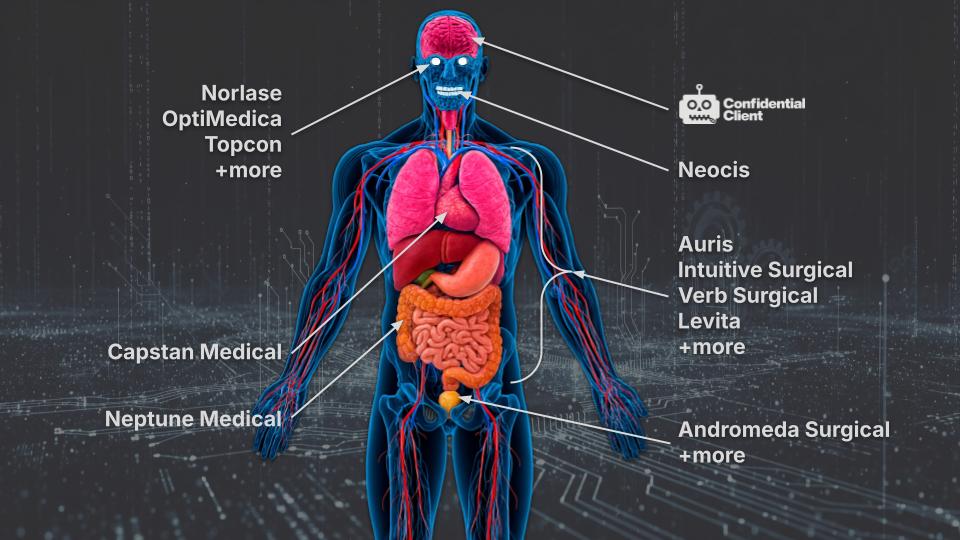
Surgical robotics is the next frontier of automation, and software is the key to unlocking its full potential. Bridging the gap between advanced hardware and clinical execution, software is what turns complex robotic systems into seamless products that scale faster, perform more reliably, and fundamentally change the ROI math for modern medical systems.
At 219, we work where software meets hardware, surgeons, and real-world operating room constraints – helping teams move faster, close skill gaps, and turn complex robotic systems into intuitive, high-performance products.
Trusted by Surgical Robotics & Medical Systems Teams
Our software is deployed in real surgical and clinical environments where performance, usability, and reliability directly impact outcomes.
What We Do Best
Graphical User Interfaces
We design and build operator-facing GUIs with a deep focus on Human–Computer Interaction (HCI). But our work goes far beyond “building a GUI.”
Capabilities include:
- Advanced GUI development for surgical robotics and laser surgery systems
- Visual overlays, depth cues, and 3D tool visualization
- Virtual representations of tools when direct line-of-sight is impossible
- Performance tuning for refresh rate, depth of field, and perceptual clarity
- Internationalization and global-ready GUI architecture
Data Visualization, Simulation & Test Tooling
Medical software can’t wait on hardware. We build simulators and visualization tools that allow teams to develop, test, and demo software early. These tools accelerate development, reduce risk, and often become long-term assets for engineering and marketing teams.
Our experience includes:
- Hardware simulators for GUI and system development
- Data visualization tools for massive log files
- Internal engineering tools that surface system behavior and performance
- Simulation environments for demos, development, and testing
Beyond ROS: Performance, Migration & Optimization
Many robotic platforms start with ROS and eventually hit performance, scalability, or certification limits. We help teams move forward. Whether evolving a research system or modernizing a commercial platform, we bring clarity to specs, constraints, and tradeoffs from the bottom up.
We support:
- Migration from ROS to bespoke, production-grade systems
- Communication protocol transitions (ROS → RTI DDS, gRPC, Protobuf)
- Data-driven analysis of network bottlenecks
- Optimization of organically grown architectures
Custom OS, Toolchains & Bare-Metal Deployment
Surgical robotics doesn’t run in the cloud, it runs on purpose-built machines in the OR. We help teams maintain secure, auditable systems that remain stable over years of clinical use.
Our expertise includes:
- Custom Linux and QNX builds
- Yocto-based OS customization and upgrades
- Toolchain and package management
- OS migrations and long-term maintenance planning
- Bare-metal deployment pipelines for OR PCs
Rapid Prototyping & Usability Testing
We help teams validate ideas early – before they’re locked into hardware or architectural decisions. We design usability tests that mirror real surgical challenges, producing better insights than abstract interviews alone.
Approaches we use:
- Rapid GUI prototyping (including Framer-based workflows)
- A/B testing for surgical interfaces
- Realistic simulation for usability studies
End-of-Line (EOL) Test Fixtures/Automation
Reliable manufacturing depends on reliable testing. Clients value the flexibility of bringing us in as hardware evolves, especially for work internal teams often deprioritize but manufacturing depends on.
Our EOL work includes:
- Automating manual manufacturing verification tests
- Python-based test frameworks and tooling
- Packaging, release, and maintenance workflows
- Record generation suitable for regulated environments
Systems Close to the Hardware
What differentiates a 219 engineer isn’t just software skill, its experience working close to constrained hardware in complex environments.
We understand:
- Resource-constrained devices
- Heterogeneous computing environments in the operating room
- Cross-compiling and device-to-device communication
- Micro-networking that behaves more like a local “OR micro-cloud”
What Clients Get from Working with 219
Why 219
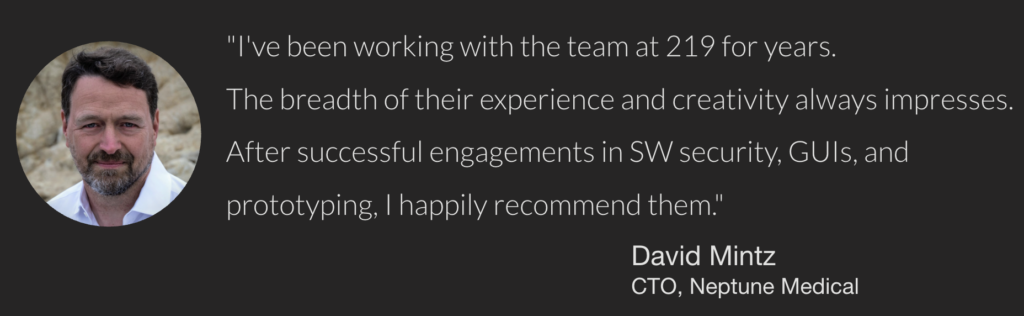
Clients come to 219 not just for individual contributors, but for a team that has already been there, done that. If you’re building the next generation of surgical robotics, and your software needs to catch up with your hardware, we can help.
- We understand surgical robotics as a system, not isolated features
- We bridge hardware, software, and human factors
- We reduce risk by applying hard-earned lessons from prior platforms
- We help teams move faster without sacrificing quality or safety
Let’s Build Software That Unlocks the Full Potential of Your Robotics Platform
If you’re building the next generation of surgical robotics or medical systems, we can help.